 |
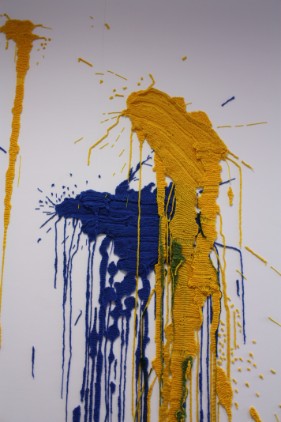
From afar the painterly gestures read as so many familiar marks of painterly abstraction. Involving the surrounding wall and floor with a quick action, a drip, splat or wallop, that was created in the process of painting. The colours I work with are inspired by the environment in which surrounds me, purely focusing on good colour compositional settings. This aspect will allow me to concentrate more on materials and colours to transform the image, and create an overall aesthetic appreciation. When viewing the paintings at a closer distance, the images begin to transform. The detail starts to appear, the material, the form along with the process completely changes. To then realise that the paintings are in fact knitted and crocheted pieces layered together to form a quick action of paint, using wool to replicate the process of paint. Here I’m allowing the audience to have two different experiences with my work, communicating labour from the scale, quantity and the technique used to transform paint. The important aspect of my practice is the physical process I go through with wool, by transforming the medium to represent a different material. Swapping wool for paint. I aim to create two stages for the audience to experience when viewing my paintings, to communicate the importance of process in representation that I have with paint through wool. ‘My work isn’t about blurring the boundaries between art and craft: it’s about redefining painting and addressing politics of representation in a way that is relevant to me.’ Dring, Rowena. Falls the Shadow. 2009 |
